Showing posts with label writing. Show all posts

Saturday, 4 January 2014

The value of the chalking wall

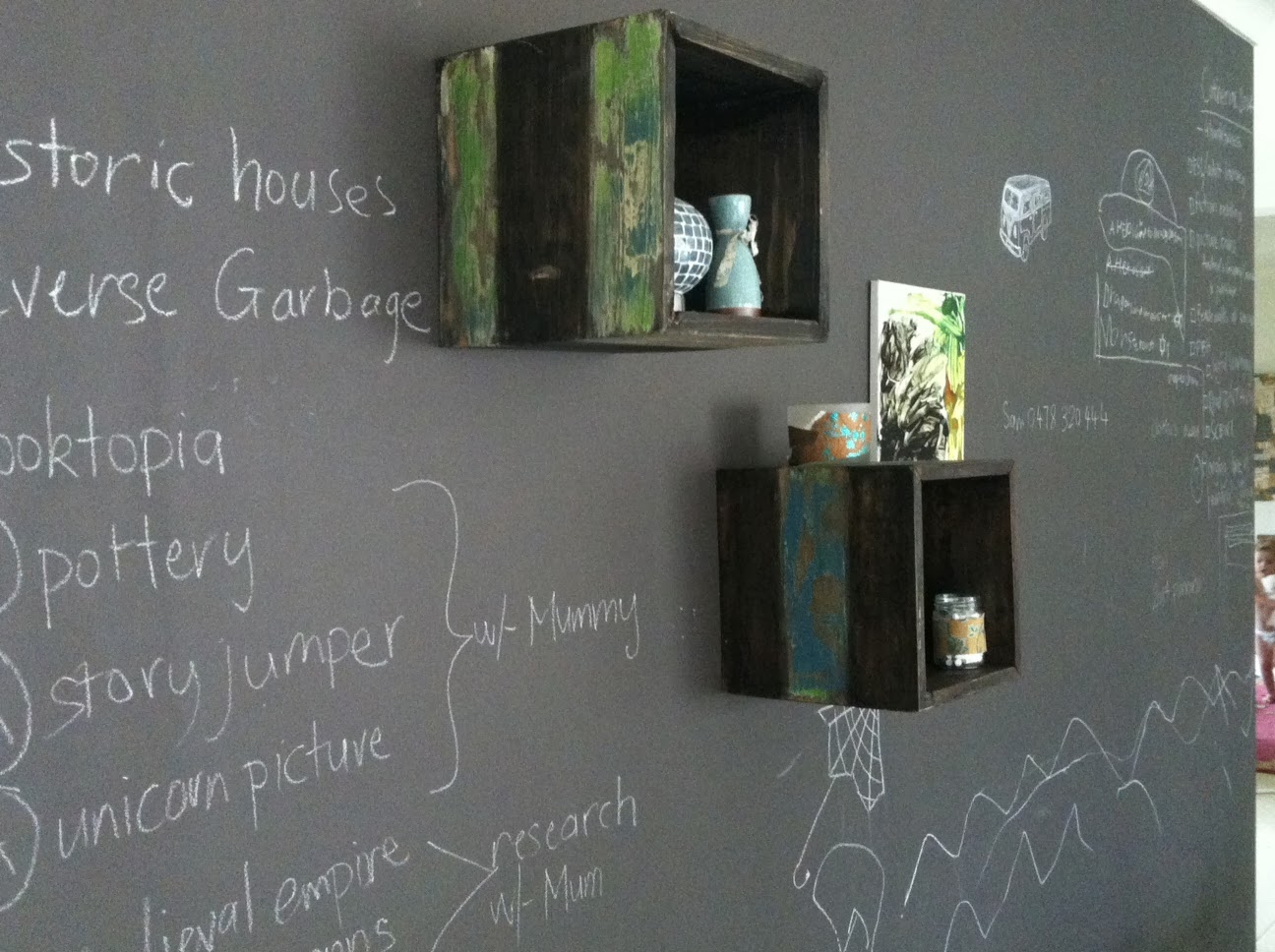
Until the recent string of public holidays, we have had a large wall covered in maps. It has been a good reference (and had a lot of visual punch when home school inspectors came to check us out). It has been a nice thing for visitors to look at and talk about-everyone comes from somewhere on a map. Most days there is a reason to look at the world map or the anatomy charts with the kids.


On an impulse, I sent the maps to the hallway and painted the giant wall with chalkboard paint.

Everyday since, I have found a new surprise on the wall. Every visitor has left their special mark. It is an invitation to play in our space; to teach and learn with us; to remember useful things.


It is also an easy way to encourage written communication for the kids. When they want me to remember something, they can write it on the wall. My husband drew up a plan for the week and we both knew what we were working toward. When I wrote my own task list of housework, I was delighted to find Steve had crossed a few jobs off the list for me.


There have been some spontaneous lessons between father and children about perspective drawing. When one visitor drew a rose, one of our kids copied it. Another visitor introduced games based around writing words backwards. !gnilleps rof noitavitoM. It has encouraged drawing on a vertical surface which is good for some low muscle tone among our children. The wall is a place to draw temporary things, which is good for perfectionists who are paralysed by permanence.


I used Murobond Society Inc Chalkboard paint in Ship Chandler (a delicious chocolatey brown). The chalk wipes off effortlessly with a damp cloth to look like a normal wall. I am very impressed with the product. I am tempted to paint a few more walls with it. I have limited myself to a handy rectangle of chalkboard in the laundry for listmaking. The cubby house will get a dose of some of the fruity chalkboard colours available at some stage. It is lovely to start the new year with useful novelty!
Image from here

Sunday, 17 November 2013

Learning to empathise with new writers

I really want my kids to feel comfortable writing. There is something about writing which untangles thoughts. I can't think something through thoroughly without writing about it in some way. There is also the outwardness of writing. Words let us open our mind to others. Writing gives thoughts permanence.

But most of us don't start writing with ease. The more we write, the better writer we become. It takes practice and it takes time. Calm, unhurried time. Writing is driven along by purpose. None of these things can be fast tracked.

Writing is complex. Thoughts need to become words. Words need to be strung into sense. Sense needs to be knit into a sentence and another and another. The sentence needs to get through arms, hands and a pencil onto a page. The pencil needs to make marks on a page which make sense to someone else. There are a thousand rules, from the sounds which are formed when they combine in different ways, to the order which words ought to march in, to the punctuation which set the pace of those words.

And, when it is all new, it is hard to remember all the parts at once and by the time you get to the second word you have forgotten what you were trying to write in the first place and it is all very stressful and you know you have made a mistake so you will stop because this is not working and not fun and you are not sure why you have to write anyway when all you want to do is go and finish your cubby house in the lounge room.

Deep breath.

I had always assumed a child who is great with verbal language, and a ravenous reader, would love to write. At the same time, I imagined that a child who took more time to become a fluent speaker and reader would find writing more difficult. It's wonderful how often chlidren turn our assumptions upside down.

I have had to learn to slow down and study my kids when it comes to writing. I am learning where their writing stress points are. I am discovering which contexts and purposes generate a fruitful writing experience for each individual. When they are having a writing experience they feel good about, I need to make sure I don't fiddle with the delicate ecosystem the happily writing child is growing in.

It is precious to have a friendly relationship with writing. We're working on small goals so that it's not unnecessarily laborious. I would rather do a little bit of cheerful writing related work with children regularly, than a stressful slab. That way, it is more likely to become something they just do everyday, like reading and eating and brushing their teeth.

I have tried a few things which have been positive:
  • Not tackling every aspect of writing at once. Treating skills separately. Handwriting. Typing. Composition.
  • Choosing a favourite sentence from a favourite story and copying it.  While reading The Hobbit, riddles were favourite things to copy. We only did this once or twice a week for a couple of months. It was enough to help our son feel better about handwriting. It was a nice way to linger in well crafted phrases too.
  • Sitting with a child as they narrated a story. I would write it down exactly as they spoke it, without corrections. This is good for children who are not yet reading or writing, but also for early writers. That way, hands don't have to keep pace with brain. Very fun for the scribe too!
  • We would read back the narrated story on a different day. The child would notice irregular sentences. This introduced them to the concept of editing and drafting. It lets them approach their text as the author and the reader, scribbling all over a page as words are rearranged, removed and replaced. This is something Donald Graves was keen on.
  • We have some story telling cards, which the kids would lay out (as many or as few as they wanted). They order the pictures to create their own plot. Then they would tell the story as they went.
  • The three biggest kids began telling each other stories and recording them on video. This was fun. This allowed composition to happen away from the hand writing and conventions of written language. It also didn't require me to sit down and write.

Mostly, we are building our friendship with writing as we read a lot of great books. I'd love to hear writing experiences others have had!

Friday, 8 November 2013

"Children want to write"

I can't remember hearing about the late Donald Graves before. I found an old book about his Australian tour in 1980. Published in 1981, it's as old as me.


I resisted the urge to dismiss what looks out of date and found wonderful guidance and reassurance. It is helping me to mentor my kids into written communication in a way which doesn't kill their confidence or love for communication. You can read an article by Graves here. I have found the following observation to be true in my older children,
Very young children, ages 5 through 7, have very little difficulty choosing topics, especially if they write every day. As children grow older and experience the early effects of audience, even under favorable learning conditions, they begin to doubt what they know. From that point on, all writers go through a kind of doubting game about the texts they produce. They learn to read better and are more aware of the discrepancy between their texts and their actual intentions. If, however, overly severe, doubting teachers are added to the internal doubts of the child, writing becomes still more difficult. From here.
We often panic about the mechanics of writing (handwriting, punctuation, spelling, grammar) and hurry children through what could be a really rich learning process if we gave them time, space, freedom and encouragement. I will post in the near future about what I am doing to develop writing with my kids.

I was reading an interview with Donald Graves and like his response to this question. It sums up my teaching and learning aspiration; learning alongside my children.
Q: If you had to choose one thing teachers should do when teaching writing, what would it be?
Donald: Write yourself. Invite children to do something you're already doing. If you're not doing it, Hey, the kids say, I can't wait to grow up and not have to write, like you. They know. And for the short term and the long term, you'll be doing yourself a favor by writing. All of us need it as a survival tool in a very complex world. The wonderful thing about writing is that it separates the meaningless and the trivial from what is really important. So we need it for ourselves and then we need to invite children to do what we're doing. You can't ask someone to sing a duet with you until you know the tune yourself.
So, my first step in helping my kids grow into writing is to slow down and write myself.

Monday, 28 October 2013

Zines: Kids taking charge of their own writing

I hardly know a thing about zines. I was never cool. It's pronounced, "zeens", if you are as ignorant as me. Zines are little, independent, low budget, self-publications. A bit like a photocopied blog, from an era when blogs didn't exist. They can be about anything, usually combining images and text, and then run through a photocopier. Black and white mini magazines ready for an audience.

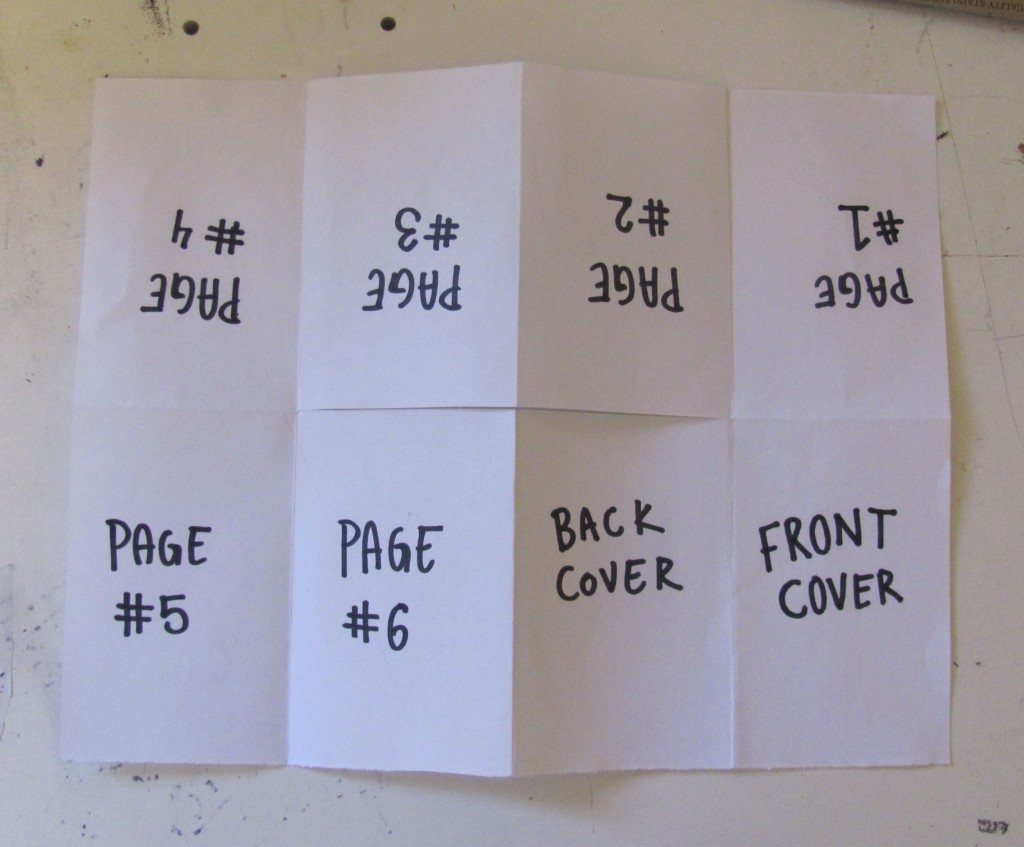
In trying to understand the zine, I found a handy little tutorial on how to make one from a single piece of paper. The idea is, you can do the layout of the entire zine on one page, whip it through the copier and fold into a booklet. It fits in an envelope, ready to post to all your eager, cool fans. Ours are micro, as I only had A4 paper. Click here for a complete tutorial.


It appears that children write best when they initiate and care about their own project. I have started folding a batch of zines so the kids can make up their own little publications. One child in particular is quite into it.

I wonder if we can make an Advent Calendar out of 25 zines...or maybe Christmas card zines?